Project Code: PRJ-MRN6-FLR-RCV
Objective
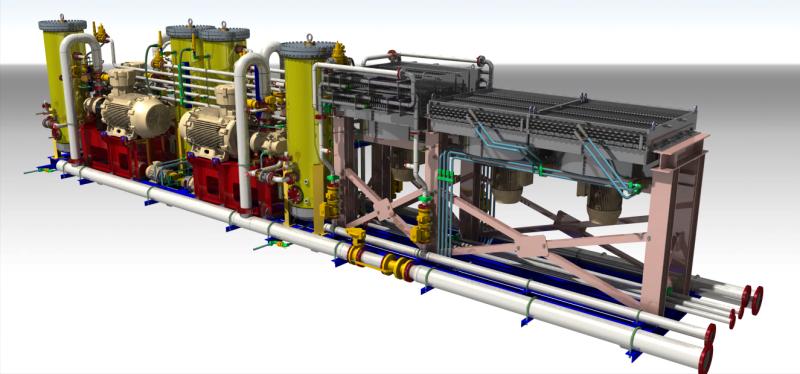
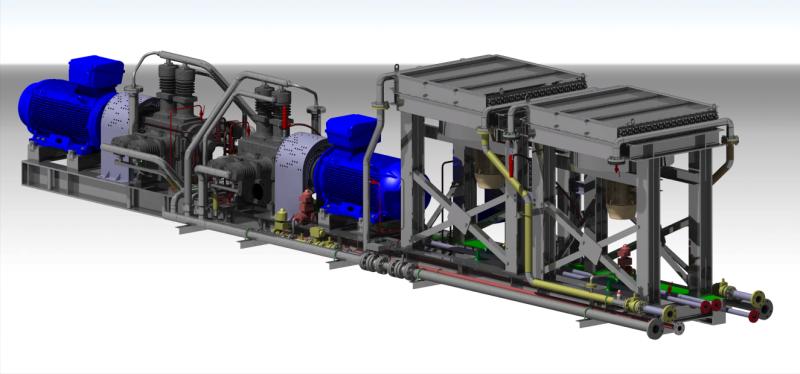
Design and development of a modular flare gas recovery station for the Marun 6 oil field in southern Iran. The system was engineered to collect low-pressure flare gas, remove contaminants and moisture, and compress it in two stages for reinjection into the production network — reducing environmental impact and recovering valuable hydrocarbon resources.
Problem Statement
Excessive flaring at Marun 6 caused significant resource loss and environmental damage. The project required a compact, explosion-proof mechanical system capable of processing contaminated flare gas starting at 0.5 bar and compressing it to 40 bar via staged compression — all within the constraints of two containerized skids, designed for transportability and on-site space limitations.
My Role
- Served as Mechanical Designer at Tamkar Gas Equipment Co.
- Modeled the entire system using CATIA V5, based on concept inputs from senior engineers
-
Responsibilities included full 3D layout and modeling of the two-stage compression system:
- Stage 1: Oil-injected screw compressor (0.5 → 16 bar)
- Stage 2: Reciprocating compressor (16 → 40 bar)
- Detailed design of gas-liquid separators, filters, dryers, demisters, and oil coolers
- Modeled modular skid structures (two 18-ft containers) and complete piping/tubing networks
-
Selected and positioned OEM components (e.g., Parker, Swagelok) including:
- Swivel joints, check valves, relief valves, safety valves, and instrumentation valves
- Schedule 40 carbon steel pipes, flanges, and fittings
- Collaborated with QA and instrumentation teams to enhance understanding of field constraints, ATEX zones, and pressure regulation
Technical Details
- Software Used: CATIA V5
-
Design Standards Applied:
- ASME B31.3 – Process Piping
- ASME B16.5 – Flanges and Fittings
- ASME B36.10M – Steel Pipes (Schedule 40)
- ISA Standards – Instrumentation and Tubing
- ATEX Directive 2014/34/EU – Hazardous Area Design
- ASME Section IX – Welding Qualifications
Process Overview
- Transformed conceptual layouts into production-ready 3D assemblies
- Designed components to fit within modular skids for compact installation
- Generated detailed 2D drawings and BOMs for procurement and fabrication
- Ensured compliance with pressure integrity, service accessibility, and ATEX requirements
Challenges and Solutions
- Low inlet pressure (0.5 bar): Solved via two-stage compression with intermediate buffering
- Explosion-proof requirements: Met through ATEX-compliant component selection and zone classification
- Limited installation space: Addressed with vertically stacked, container-based skid design
- Lack of local precedents: Overcome through international standard review and OEM technical literature
Results
- Delivered complete mechanical design package with 3D models, fabrication drawings, and specifications
- Project implemented with ~$1M investment funded by Iran’s Innovation and Prosperity Fund
- Recognized as a national benchmark in flare gas recovery and emissions control
- Advanced domestic capabilities in high-pressure gas system design and sustainable energy solutions